
Analysts have started talking about at least a 25 bps cut immediately.
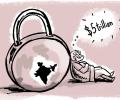
In order to achieve $5 trillion GDP by FY'25, India needs to spend about $1.4 trillion over this period on infrastructure, according to the Economic Survey. During financial years 2008-17, India pumped in about $1.1 trillion on infrastructure. However, the challenge is to step up infrastructure investment substantially, the Economic Survey 2021-22 said.

The Budget oration of the finance minister and the confidence with which she delivered it, along with the measures and the recent upsurge in the economy would all contribute to unleashing the storied 'animal spirits' and help the economy run on the growth path quite smoothly. Or so the government hopes, notes Shreekant Sambrani.

'We forecast real GDP growth to moderate to 6.7 per cent in the year ending March 2018.' 'However, as disruption fades, we expect to see a rebound in real GDP growth to 7.5 per cent in the next fiscal year.'

The divestment process, however, will not be an easy affair as there are multiple stakeholders, including the employee unions, whose concerns will have to be addressed.

Economic growth is likely to plummet to a multi-decade low of 1.6 per cent in fiscal year 2020-21 due to the Covid-19 pandemic and ensuing measures like lockdowns and social distancing, an American brokerage said on Wednesday in one of the bleakest forecasts on GDP yet. Indian policymakers have not been aggressive enough in their response till now to the crisis, and will need to eventually intensify their efforts, economists at Goldman Sachs said.

Lack of skilled labour, among other factors, led to 187,062 vacancies in nine sectors during the first quarter of the current fiscal year, showed the new revamped quarterly employment survey (QES). This accounted for a little over 0.6 per cent of the total jobs given by these establishments till April-June 2021-22. The nine sectors - manufacturing, construction, trade, transport, education, health, accommodation and restaurants, IT/BPOs and financial services - employed 30.8 million people.

The World Bank on Sunday said the coronavirus outbreak has severely disrupted the Indian economy, magnifying the pre-existing risks to its outlook. In its 'South Asia Economic Update: Impact of Covid-19', the World Bank estimated the Indian economy to decelerate to 5 per cent in 2020 and projected a sharp growth deceleration in fiscal 2021 to 2.8 per cent in a baseline scenario.

The Indian Railways has decided to not cancel any more passenger trains to accommodate more freight traffic for coal transport. It will also gradually restore the ones it cancelled recently. The national transporter is of the view that coal supply is now reaching normative levels and does not need any more special measures. "Early data suggests that coal supply has stepped up since the passenger trains were cancelled.

India's manufacturing sector activities gained further strength in October as companies scaled up production and stepped up input purchasing in anticipation of further improvements in demand, a monthly survey said on Monday. Robust gains in new work aided production growth in October as output and new orders expanded at fastest rates in seven months, while business optimism hit a six-month high, the survey said. The seasonally adjusted IHS Markit India Manufacturing Purchasing Managers' Index (PMI) rose from 53.7 in September to 55.9 in October, pointing to the strongest improvement in overall operating conditions since February.

The G-20 leaders under the chairmanship of Saudi Arabia's King Salman held an extraordinary video conference in which they resolved to use all available policy tools to minimise the economic and social damage from the pandemic that has killed over 21,000 people and infected more than 470,000 globally.

As India emerges from the COVID-19 crisis, the ninth budget under the Modi government, including an interim one, is widely expected to focus on boosting spending on job creation and rural development, generous allocations for development schemes, putting more money in the hands of the average taxpayer and easing rules to attract foreign investments.

'It will be a cat and mouse game between investors and the government.' 'The issue will be launched only if there is sufficient demand from investors and the government is in agreement with the bankers on the valuations.'

The survey, however, said that GDP is expected to revert to growth terrain next year, when it is likely to grow by 7.2 per cent.

The government currently holds 87.40 per cent stake in IRCTC. To meet Sebi's public holding norm, it has to lower its stake in the company to 75 per cent.

Paytm's Rs 18,300-crore IPO -- India's largest public issue to date -- was subscribed only 18 per cent on the first day of bidding on Monday.

West Bengal has received total investment proposals worth around Rs 2.43 lakh crore spread across sectors like education, health, mining, steel, infrastructure and financial services during the two-day Bengal Global Business Summit, which concluded in Kolkata on Thursday.

Voters can be relied on to punish a party which makes reckless promises without actually implementing them, asserts Virendra Kapoor.

'Tenants who pay rent above the threshold limit must be extra cautious about TDS fillings.'

'Several businesses like entertainment, hospitality, travel etc would never be the same again.'

Officials asked what the point was in going through banks when the government has to give guarantees.

Risk aversion is currently a dominant depressant to economic recovery, points out Shankar Acharya, former chief economic advisor to the Government of India.

'We can go somewhere between 35 per cent and 40 per cent.'

'It is entering growth territory on a month-on-month basis.'

An influential immigration advocacy group representing Indian-Americans on Thursday urged the Biden administration not to issue the most sought-after H-1B work visa to any individual born in India, till the time the discriminatory country-cap on green cards or permanent legal residency is removed. The current per-country cap on issuing of green cards in the US has resulted in Indian professionals, mostly from the IT sector, having to wait for decades for their legal permanent residency. Issuing new H-1B visas to more Indians would add to this agonising painful wait for green cards, Immigration Voice said in a statement.

Finance Minister Nirmala Sitharaman will present the much-awaited 2022-23 Union Budget on February 1. While there has been strong recovery in some sectors, touch services like hospitality, tourism and leisure continue to suffer after two Covid-19 waves. Household savings have been hit due to increased spending on health care. Consumption has still not reached pre-pandemic levels.
A total of 22,27,506 farmers have obtained loan of about Rs 10,736 crore from cooperative banks in the state.

India Inc's cash pile was up 13.8 per cent last fiscal year, thanks to a combination of higher profits in sectors such as IT and fund raising by top companies such a Reliance Industries, Bharti Airtel and Tata Motors, among others.

The ministry has got Rs 1,03,927 crore for 2019-20 which is 4.9 per cent more than Rs 99,034 crore given in 2018-19.

India's aggregate NPA as a percentage of GDP is far lower than that in Italy, Greece.

Retail prices of three pulses -- tur, moong dal and urad -- are on a declining trend after the government took coordinated actions with state governments to check hoarding, the Food and Consumer Affairs Ministry said on Friday. "The upward pressure on retail prices of tur, moong dal and urad has stabilized in 2021 and is on a stable or declining trend," it said in a statement. According to the ministry, the average increase in prices of these three pulses during April to June 16, 2021 was 0.95 per cent as compared with previous three months (January-March, 2021).

'When you start distributing wealth, you end up distributing poverty.'

JM Financial, Axis Bank, and Bank of America have been roped in as the bankers to run the mandate, say sources.

There have been some benefits to the corporate sector, agreed they also need support, but the government should realise that the economy is not suffering from lowering investment -- people are ready to invest but where is the demand?

'India is possibly the most fiscally constrained market in the region.'

Getting the balance between fiscal restraint and growth-contracting policy remains a problem.

Companies in China, South Korea and Indonesia pay 25 per cent tax, while those in Malaysia pay 24 per cent. Only Japan has a higher tax than India at 30.6 per cent. Hong Kong has the lowest corporate tax rate of 16.5 per cent while Singapore has 17 per cent rate and Thailand and Vietnam levy 20 per cent tax on companies.

Non-banking finance companies face renewed asset quality and liquidity risks amid a second wave of COVID-19, Fitch Ratings said on Thursday. These challenges are likely to increase if recent restrictions to contain the pandemic are expanded or prolonged, leading to greater economic and operational disruption, it added. The rating agency further said that an increase in the rate of infections and broadening of social distancing restrictions pose downside risks to its 12.8 per cent growth projection for the current fiscal.

The sweeping economic sanctions on Russia - the second largest producer of crude oil - following its invasion of Ukraine late last month can cull global and domestic growth along with the added pains of higher inflation and currency depreciation, RBI Deputy Governor Michael Patra has said. And if the war lingers on, it can even lead to deglobalisation and even a recession, he added. The ongoing war has only added a whole new dimension to the outlook, and in fact, a weighty downside, Patra said in a lecture at the industry lobby IMC on Friday evening.

Retirement fund body EPFO net added 14.81 lakh subscribers in August 2021, reflecting a growing trend in net payroll for the first five months of this fiscal. The provisional payroll data of Employees' Provident Fund Organisation (EPFO) released on Wednesday highlights that it added around 14.81 lakh net subscribers during the month of August 2021, a labour ministry statement said. The data reflects a growing trend in net payroll for the first five months of the current financial year, it added.
